

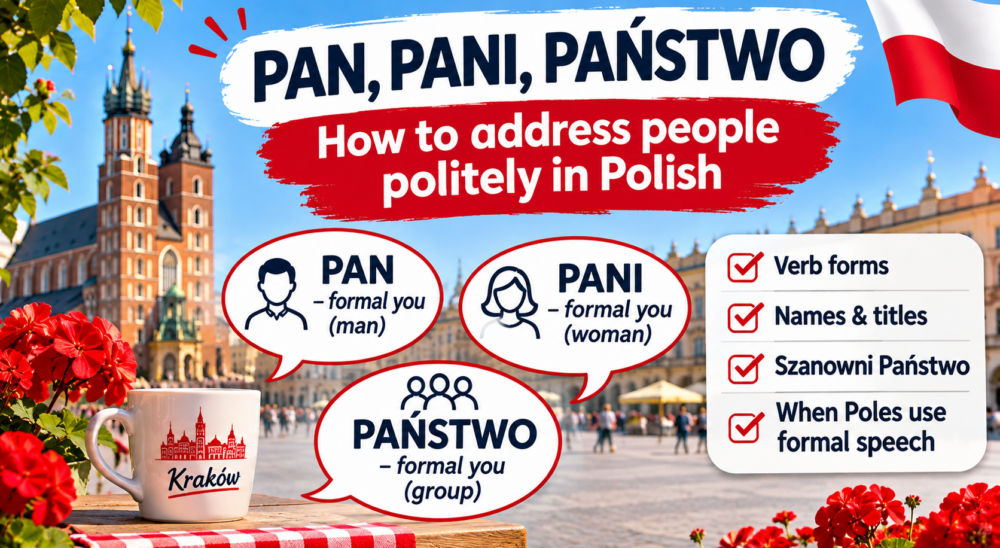
Pan, Pani, Państwo – How to Address People Politely in Polish
If you’re learning Polish, one of the first things you’ll notice is that Polish speakers use formal forms of address much more frequently than English speakers do. In English, we simply use you when talking to a friend, a stranger, our boss, or someone much older than us. Polish, however, distinguishes between informal and formal ways of addressing people.
Instead of using ty (you, singular), Polish speakers often use pan, pani, or państwo. These forms are an important part of everyday communication, whether you’re in a shop, at a restaurant, at work, or talking to someone you’ve just met.
In this article, we’ll look at how pan, pani, panowie, panie, and państwo are used, how they work with names, and why Polish speakers don’t switch to informal speech as easily as English speakers often do.
1. Pan and Pani – the basics of formal address
Beginner tip: At the A1 level, simply remember to use pan when addressing an unfamiliar man and pani when addressing an unfamiliar woman, together with a third-person singular verb.
In Polish, pan and pani are used to address someone politely. They roughly correspond to the formal English you, although they can also mean sir, gentleman, lady, or madam, depending on the context.
- pan – formal you, used when addressing a man; also means gentleman or sir
- pani – formal you, used when addressing a woman; also means lady or madam
Using pan or pani doesn’t necessarily mean the conversation is extremely formal. It’s perfectly normal for two people who have never met before, even if they’re the same age, to use these forms in everyday conversation.
Examples
| Polish | English |
|---|---|
| Czy pan mówi po polsku? | Do you speak Polish? |
| Czy pani mieszka w Warszawie? | Do you live in Warsaw? |
| Czy pan jest nauczycielem? | Are you a teacher? (to a man) |
| Czy pani jest nauczycielką? | Are you a teacher? (to a woman) |
| Czy pan chce kawę? | Would you like a coffee? |
| Czy pani ma czas? | Do you have time? |
Which verb forms do we use?
When using pan or pani, the verb is conjugated in the third-person singular, just as it would be with on (he) or ona (she).
For example:
- Czy pan mówi? – Do you speak?
- Czy pani mówi? – Do you speak?
- Gdzie pani mieszka? – Where do you live?
This is one of the most important things to remember when learning formal Polish.
- Czy pan masz czas? – Incorrect!
- Czy pan ma czas? – Correct! (Do you have time?)
Even though you’re talking directly to someone, the verb follows the third-person pattern.
2. Panowie, panie and państwo – addressing groups
Beginner tip: If you’re addressing a group, learn these three forms first: panowie for men, panie for women, and państwo for a mixed group.
When addressing several people politely, Polish uses different forms depending on the composition of the group.
| Polish | English | When do we use it? |
|---|---|---|
| panowie | gentlemen / formal you (men) | A group consisting exclusively of men |
| panie | ladies / formal you (women) | A group consisting exclusively of women |
| państwo | formal you (plural) | A mixed group of men and women |
These words can also be used as nouns, not just as forms of address:
- panowie – gentlemen
- panie – ladies
- państwo – ladies and gentlemen, or in certain contexts a married couple or family
Examples
- Panowie, czy możemy zaczynać? – Gentlemen, can we begin?
- Czy panie mają rezerwację? – Do the ladies have a reservation?
- Czy państwo mieszkają w Polsce? – Do you live in Poland?
3. How do you address someone by name? Panie Janie, Pani Anno…
Beginner tip: You don’t need to learn the vocative case at the beginner level, as it can often be omitted in everyday speech.
When using pan or pani with someone’s name, Polish often changes the form of the name. This is because Polish uses the vocative case (wołacz) when directly addressing someone.
Panie + a man’s first name
When politely addressing a man by his first name, we use panie followed by the vocative form of the name.
| Basic form | Direct address |
|---|---|
| Adam | Panie Adamie! |
| Andrzej | Panie Andrzeju! |
Pani + a woman’s first name
Women’s names also change in direct address.
| Basic form | Direct address |
|---|---|
| Anna | Pani Anno! |
| Maria | Pani Mario! |
Regardless of the form of the name, we still use the formal verb:
- Panie Piotrze, czy pan rozumie? – Peter, do you understand?
- Pani Anno, czy pani rozumie? – Anna, do you understand?
Pan + last name
Pan and pani can also be used with a last name, especially when referring to someone.
- Pan Kowalski jest lekarzem. – Mr. Kowalski is a doctor.
- Pani Nowak pracuje w banku. – Ms. Nowak works at a bank.
- Czy pan Kowalski jest tutaj? – Is Mr. Kowalski here?
When directly addressing someone, the last name may also appear in the vocative form: Panie Kowalski! or Pani Nowak! Women’s last names often remain unchanged.
First name or last name?
Using pan/pani with a first name is often a little more familiar and less distant than using a last name, while still being polite.
- Panie Adamie, czy może pan… – Adam, could you…?
- Pani Kasiu, czy może pani… – Kasia, could you…?
You’ll hear these forms in workplaces and in everyday situations where people know each other but still use formal address.
4. Szanowni Państwo – a common formal expression
Beginner tip: For now, simply recognize Szanowni Państwo as a formal way of addressing a group of people.
- Szanowni Państwo* is one of the most common formal expressions in Polish. Depending on the context, it can be translated as Dear Ladies and Gentlemen, Dear Sir or Madam, or simply a formal way of addressing an audience.
It’s commonly used when addressing an audience or a group of people in a formal setting.
You may also come across expressions such as Szanowni Panowie (Dear Gentlemen), Szanowne Panie (Dear Ladies), or Szanowna Pani Profesor (Dear Professor), but you don’t need to learn all of these at the beginner level.
5. Państwo – not just formal “you,” but also a couple or family
Beginner tip: For now, remember państwo primarily as the formal plural form of “you”; its use for married couples and families can come later.
In Polish, państwo can also refer to a married couple or a family, rather than simply being a way to address a group of people.
For example:
- Państwo Kowalscy mieszkają w Warszawie. – The Kowalski couple lives in Warsaw.
- Czy państwo Nowakowie są w domu? – Is the Nowak family at home?
- Państwo Kowalscy mają dwoje dzieci. – The Kowalski couple have two children.
In these sentences, państwo refers to a couple or family rather than functioning as formal “you.”
Compare:
- Czy państwo mają dzieci? – Do you have children?
- Państwo Kowalscy mają dzieci. – The Kowalski couple have children.
6. Pan and Pani when addressing your in-laws
Beginner tip: Treat this as a cultural note for now: in some Polish families, people address their spouse’s parents as mamo and tato.
In some Polish families, people address their mother-in-law and father-in-law using mamo and tato (Mom and Dad).
This may seem unusual to English speakers, but in Poland, calling your spouse’s parents mamo and tato can be perfectly natural.
- Mamo, czy mogę ci pomóc? – Mom, can I help you?
- Tato, co robisz? – Dad, what are you doing?
- Mamo, dziękuję za obiad. – Mom, thank you for lunch.
The forms mamo and tato are the vocative forms of mama and tata.
This isn’t a universal rule, however. Family traditions differ. Some people use first names, some use mamo/tato, and others may initially use formal pan/pani forms.
7. Polish speakers don’t switch to informal speech as easily as English speakers often do
Beginner tip: When talking to strangers, shop employees, office staff, or most people you don’t know, start with pan/pani rather than ty.
In Polish, formal address is much more common in everyday communication than it is in many English-speaking contexts.
When talking to strangers, older people, employees, or service providers, it’s generally safer to use pan or pani rather than immediately switching to informal ty.
When do people switch to informal speech?
The switch to informal ty usually happens when both people feel comfortable with it, or when one person explicitly suggests it.
In Polish, there’s a phrase for this:
Przejść na ty – to switch to informal address.
For example:
- Może przejdziemy na ty? – Shall we switch to informal address?
- Możemy mówić sobie na ty? – Can we use informal forms with each other?
- Proponuję przejść na ty. – I suggest we switch to informal address.
Sometimes an older person or someone in a higher position may offer to switch to ty. This can be associated with a symbolic gesture called bruderszaft (from the German Bruderschaft), sometimes referred to colloquially as brudzia.
8. Pan and Pani in casual, playful, or ironic conversations
Beginner tip: Stick to standard pan/pani forms and third-person verbs for now; simply recognize that formal address can also appear in playful or ironic conversations.
Using pan or pani doesn’t always mean that the conversation is stiff, distant, or strictly formal. Polish speakers sometimes continue using these forms even when the conversation becomes quite casual.
Depending on the tone, context, and relationship between the speakers, formal address can sound playful, direct, ironic, humorous, or even sarcastic.
For example:
- Pani to jest bardzo miła! – You’re really nice!
- Pan sobie żartuje? – Are you kidding me?
- Pani chyba mnie nie rozumie. – I don’t think you understand me!
- Pan jest niemożliwy! – You’re impossible!
The form doesn’t necessarily mean that the speakers are strangers or that they’re trying to be particularly polite. The tone and context matter.
9. Panie Jurku, dajesz ten list? – when formal address is combined with informal verb forms
Beginner tip: Don’t imitate this construction; learn standard informal and formal Polish first. This is a C1/C2-level language-use phenomenon!
In Polish, you may occasionally encounter a style of speech in which pan or pani is used together with a second-person singular verb form, rather than the standard third-person form.
For example:
- Panie Jurku, dajesz ten list? – Jurek, are you giving me that letter?
- Pani Kasiu, przyniesiesz mi kawę? – Kasia, will you bring me some coffee?
- Panie Andrzeju, chodź tutaj! – Andrzej, come here!
In standard Polish, these combinations are unusual because panie/pani normally goes with third-person verb forms. In the examples above, the speaker combines the formal or honorific form of address with informal second-person singular verbs.
This kind of speech may occur in certain colloquial, rural, folk, or socially specific speech styles. It doesn’t necessarily express deliberate disrespect, but compared with standard Polish, it can sound rough, blunt, or even rude in some situations. The interpretation depends heavily on the relationship between the speakers and the context.
How would you say the same thing in standard Polish?
| Style | Polish | English |
|---|---|---|
| Informal | Proszę, daj ten list. | Please, give me that letter. |
| Informal | Dasz ten list? | Will you give me that letter? |
| Formal | Proszę dać ten list. | Please give me that letter. |
| Formal, with direct address | Panie Jurku, proszę dać mi ten list. | Jurek, please give me that letter. |
| Formal | Niech pan da mi ten list. | Please give me that letter. |